
Guide
What Happens When an Owner Pays a Business Expense Personally?
Published · By RecordSplit
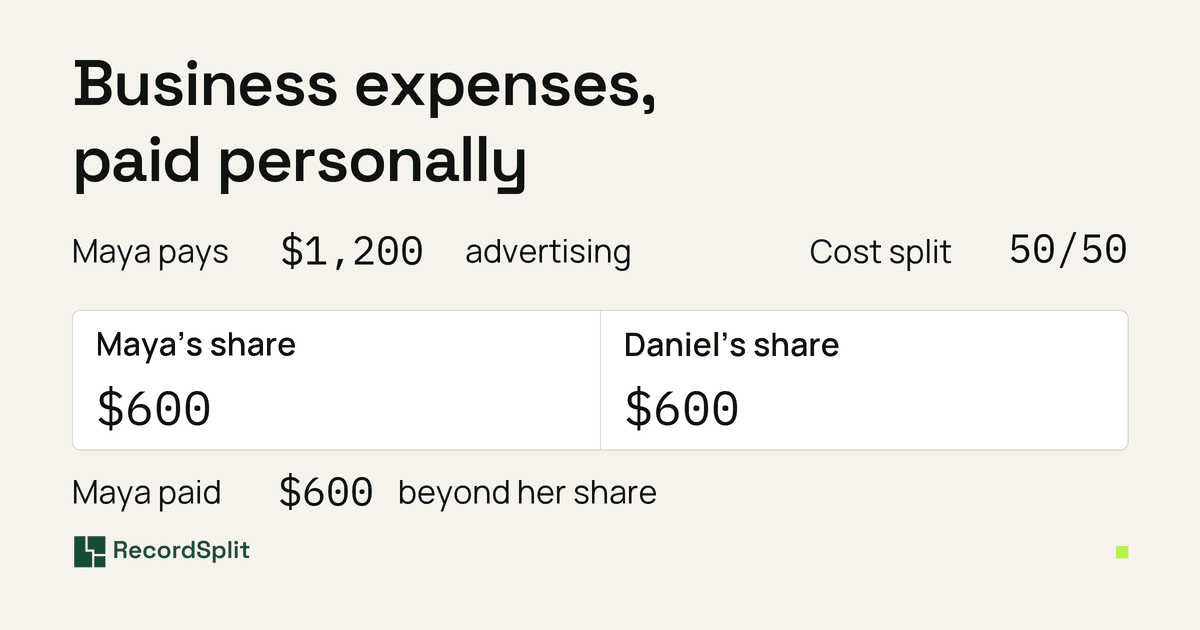
When an owner pays a genuine business expense with personal money, the cost is still a business expense. The full amount reduces the business's profit. What changes is who funded it: an owner, rather than the business.
In a business with more than one owner, that matters. The owner who paid has covered more than their share of a shared cost, so the record should show who paid as well as what was bought. RecordSplit records the payer on each expense, and an owner-paid expense moves that owner's partner balance in their favor under the business's partnership rules.
Why owners end up paying business costs
Definition
It happens in almost every small business with more than one owner, usually for ordinary reasons:
- A supplier only takes a card the business doesn't have, so an owner uses a personal one.
- A bill is due before money reaches the business account.
- An owner buys something for the business while travelling or out of hours.
- The business hasn't opened its own account yet.
None of this is a problem on its own. Problems start when the cost is recorded without the payer, or recorded as something it isn't — as money the owner put into the business, or as a personal expense the business ignores.
A note on tax
A worked example
Maya and Daniel run a design studio. Their partnership rule splits owner-paid expenses 50/50. Maya pays a $1,200 advertising bill on her personal card. Assume nothing else has happened.
- Business expense (advertising)
- $1,200.00
- Paid personally by Maya
- $1,200.00
- Maya's 50% share of the cost
- $600.00
- Daniel's 50% share of the cost
- $600.00
- Paid by Maya beyond her own share
- $600.00
Example figures, not customer data.
The studio's expenses go up by $1,200 and its profit goes down by the full $1,200. Maya covered $600 more than her own share of the cost, so under those assumptions that $600 contributes toward a suggested settlement from Daniel to Maya.
Real partner balances are rarely made of one expense. They also include other owner-paid expenses, revenue an owner received personally and any settlements already recorded, all under the business's own partnership rules.
What happens to profit
In short
Profit is revenue minus expenses. The $1,200 advertising bill is a business expense whoever paid it, so the studio's profit is $1,200 lower — not $600, and not zero. Splitting the cost between owners decides who bore it, not how much the business spent.
Leaving the expense out because “Maya paid it herself” overstates profit by $1,200 and loses the record of a real business cost.
The lower profit is what the owners then divide by their profit shares. The free profit split calculatorshows each owner's share of a profit figure; who paid which expense is a separate question.
What happens to partner balances
A partner balance shows where each owner stands against the others, based on what each has paid and received personally for the business. Paying a shared cost personally moves the payer's balance in their favor, by the part of the cost above their own share.
The share comes from the business's owner-paid expense split, which can be equal or custom and can differ from how profit is shared. With a 60/40 split instead of 50/50, Maya's share of the $1,200 bill would be $720 and the part above her share $480.
Expenses paid from the business account don't change partner balances: no owner covered them personally. See partner finance for everything a partner balance is built from.

Paid personally vs paid by the business
Now suppose the studio's business account pays the same $1,200 advertising bill. The expense is still $1,200 and profit still falls by $1,200. The difference is that business funds paid it, so no owner personally funded the cost and the expense creates no owner-paid difference between Maya and Daniel.
The two records differ in one field — who paid — and that field decides whether owners' balances move. Profit is the same either way.
Owner-paid expense vs capital contribution
In short
If Maya transfers $1,200 into the business account to fund it, that is a capital contribution: no expense exists and profit doesn't change. If she pays a $1,200 supplier bill herself, the business has a $1,200 expense and lower profit. Recording the bill as a contribution would hide a real cost and overstate profit. More on capital contributions.
Owner-paid expense vs owner's draw
In short
A draw lowers the business's cash and doesn't touch profit. An owner-paid expense doesn't touch the business's cash at all — the money came from the owner — but it is an expense, so profit falls. More on how an owner's draw works.
Owner-paid expense vs settlement
Recording the expense and settling up are two separate events. The expense is recorded when the cost is paid. A settlement comes later, when one owner pays another to even out their balances — for example, Daniel paying Maya $600 after the advertising bill. The settlement isn't a business expense and doesn't change profit; it only adjusts the two owners' balances.
People often call this “reimbursing” the owner who paid. In RecordSplit there is no separate reimbursement workflow: the owner-paid expense feeds the partner balance, which suggests settlements, and the settlement is recorded as its own entry once it has been paid.
| Record | What happened | Expense? | Profit effect | Partner balance effect | How RecordSplit tracks it |
|---|---|---|---|---|---|
| Owner-paid expense | An owner paid a business cost personally | Yes | Reduces by the full amount | Moves the payer's balance in their favor | Expense, with Paid from set to that owner |
| Business-paid expense | The business account paid a business cost | Yes | Reduces by the full amount | None | Expense, paid from Business funds |
| Capital contribution | An owner put money into the business | No | None | None | Capital, recorded per owner |
| Owner's draw | An owner took money out of the business | No | None | None | Owner withdrawal on a business account |
| Settlement | One owner paid another to even out | No | None | Nets both owners' balances | Settlement between two owners |
How to track personally paid business expenses
Whatever you use to keep records, capture these for every personally paid cost:
- That it is a business expense, with its normal category.
- Which owner paid, and the date.
- The receipt or invoice, attached to the record.
- Whether it has been settled between the owners yet.
Agree up front how owner-paid costs are shared — equally or in set percentages — and from what date, so nobody has to renegotiate a bill after it has been paid. See how business partnerships handle this day to day.
If you keep these records in a spreadsheet, the free business partner expense tracker spreadsheet records the category, date, paying owner and settlement status of each expense, and totals what each owner paid personally.
Unreimbursed partnership expenses
How RecordSplit handles owner-paid expenses
RecordSplit is built for small businesses with more than one owner, and every expense records who paid it:
- Choose Paid from on each expense: Business funds (optionally the business account it came out of) or the owner who paid personally. Only owners taking part in the partnership on the expense's date can be chosen.
- The full amount stays in Expenses and reduces profit, whoever paid.
- Your partnership rule sets each owner's share of owner-paid expenses, from an effective date; earlier expenses keep the shares that applied when they were paid.
- Owner-paid expenses feed Partner Balance, which suggests settlements between owners. Settlements are recorded separately once paid.
- Filter expenses by who paid, and use the Expense Funding report to compare owner-paid and business-paid spending. Reports export to Excel or PDF.
- Owners record expenses and settlements. RecordSplit doesn't move money, connect to banks or cards, or calculate tax.

See expense tracking for categories, receipts and monthly reports.
Frequently asked questions
What happens if I pay a business expense from my personal account?
Is an owner-paid business expense still deductible?
Does an owner-paid expense reduce business profit?
Is paying a business expense personally a capital contribution?
What is the difference between an owner-paid expense and an owner's draw?
How do business partners track who paid an expense?
Does RecordSplit reimburse owners automatically?
Can business partners split an owner-paid expense unevenly?
Record who paid each business expense.
RecordSplit keeps every expense in profit and tracks which owner paid it, so partner balances and suggested settlements come from the same record.