
Guide
What Is an Owner's Draw?
Published · By RecordSplit
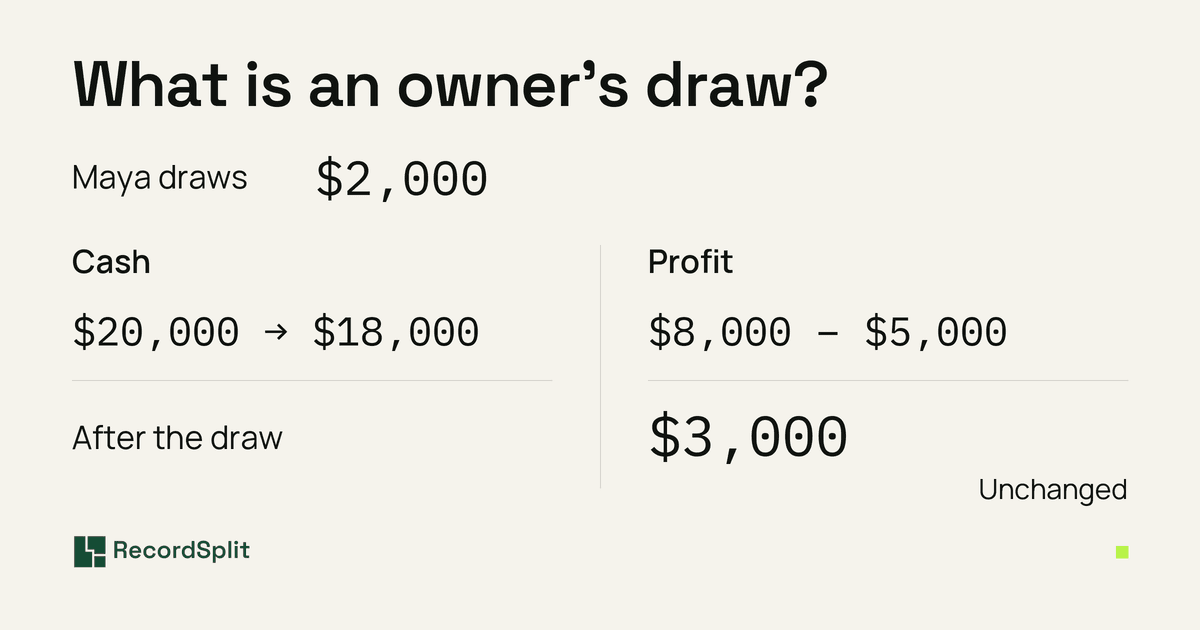
An owner's draw is money or other value an owner takes out of their business for personal use. It is not revenue and it is not a business expense, so on its own it doesn't change the business's profit — it reduces the money the business has.
Owners of sole proprietorships, partnerships and many LLCs often pay themselves this way instead of through a salary. This guide explains how a draw works, how it differs from a salary, a capital contribution, a business expense and a settlement between partners, and how to keep clear records when several owners take money out.
What is an owner's draw?
Definition
A draw is usually a transfer from the business bank account to the owner's personal account, but it can also be business property an owner takes for personal use. It is also called an owner withdrawal. In a partnership or LLC, money taken out by a partner or member may also be called a distribution; whether a particular payment counts as a draw, a distribution or something else depends on the business structure and the owners' agreement.
A note on tax and accounting
How an owner's draw works
Three things are true of an owner's draw:
- Money leaves the business and goes to an owner, not to a supplier or employee.
- It belongs to the owner who took it, so it is recorded against that owner with its date and amount.
- Revenue, expenses and profit stay where they were. Only the money held by the business goes down.
In double-entry bookkeeping, a draw is typically recorded as a decrease in the business's cash and an equal decrease in the owner's equity, often through a drawing account for that owner. It is not recorded as an expense.
Because a draw isn't an expense, profit can look healthy while the bank balance falls. Owners usually agree how much and how often each of them can draw — for example, a fixed monthly amount, or draws in proportion to ownership — and keep enough in the business to pay its bills.
An owner's draw example
Maya and Daniel own a design studio. In March the studio earns $8,000 in revenue and spends $5,000 on expenses, so its profit is $3,000. At the end of the month the business account holds $20,000, and Maya transfers $2,000 to her personal account as an owner's draw.
- Revenue
- $8,000.00
- Expenses
- $5,000.00
- Profit (revenue − expenses)
- $3,000.00
- Business account before the draw
- $20,000.00
- Owner's draw by Maya
- $2,000.00
- Business account after the draw
- $18,000.00
Example figures, not customer data.
The business account balance falls by $2,000. Revenue stays $8,000, expenses stay $5,000 and profit stays $3,000: the draw is not a business expense, so it doesn't reduce profit. What changed is how much money the business has and how much Maya has taken out.
Maya's draw doesn't automatically mean Daniel is owed $2,000, or that Daniel owes Maya anything. Whether owners should draw equal amounts, and what happens if they don't, is set by their agreement.
Owner's draw vs salary
In short
The two can look similar — money moving from the business to a person — but they are recorded differently. A salary paid to an employee reduces profit, like rent or software. A draw reduces the money in the business and the owner's equity, but not profit.
Whether an owner can or should be paid a salary instead of, or as well as, taking draws depends on the business structure and on tax rules where the business operates, so it is a question for your accountant. RecordSplit records salary payments to employees as business expenses; it isn't payroll software, so it doesn't calculate tax, issue payslips or file returns.
Owner's draw vs capital contribution
In short
If Maya puts $10,000 into the business and later takes $2,000 out, she has contributed $10,000 and drawn $2,000. Those are two separate records, not a net $8,000 contribution, and neither appears in revenue. Owners usually want both visible, because together they show how much each owner has put in and taken out over time. Read more about what a capital contribution is.
Owner's draw vs business expense
In short
Say Daniel pays the studio's $300 software subscription on his own card. The studio now has a $300 software expense and $300 less profit, the same as if the business account had paid. Nothing left the business account and nothing went to Daniel, so it isn't a draw.
The two run in opposite directions. Daniel paying a bill means he spent his own money on the business, which the owners usually pay back or settle between themselves. A draw means money went from the business to him. How business-paid and owner-paid costs are recorded is covered in expense tracking; what happens to profit and balances is explained in business expenses paid personally.
Owner's draw vs partner settlement
In short
Settlements happen between owners. If Maya has paid more than her share of the business's costs personally, Daniel might pay her back directly. That payment moves money from Daniel to Maya; it doesn't touch the business account and it isn't a draw.
A draw moves money from the business to an owner. In RecordSplit the two are separate records: a settlement is recorded between two owners and adjusts their balances with each other, while an owner withdrawal is recorded on a business account and lowers that account's balance.
| Record | Money direction | Revenue? | Expense? | Profit effect | How RecordSplit tracks it |
|---|---|---|---|---|---|
| Owner's draw | Business → owner | No | No | None | Owner withdrawal on the business account it came from |
| Capital contribution | Owner → business | No | No | None | Capital, recorded per owner |
| Revenue | Customer → business | Yes | No | Increases profit | Revenue, received by the business or by an owner |
| Business expense | Business or an owner → supplier | No | Yes | Reduces profit | Expenses, marked business-paid or owner-paid |
| Partner settlement | One owner → another owner | No | No | None | Settlement between two owners, which nets their balances |
How multiple owners can track withdrawals
When a business has several owners, unrecorded draws are a common source of disagreement. For each withdrawal, record:
- Which owner took it.
- The date and the amount.
- Which business account it came out of.
- A short note, for example the month it relates to.
Then keep three habits:
- Keep draws out of expenses, so profit isn't understated.
- When an entry is wrong, cancel it with a short explanation and keep it visible, so later questions can be answered.
- Compare each owner's withdrawals with what was agreed, so nobody is surprised at year-end.
Owners don't have to draw equal amounts, but they should agree whether unequal draws are expected, limited or evened out later.
How RecordSplit handles owner withdrawals
RecordSplit doesn't have a separate owner's-draw module. It records draws as owner withdrawals on Business Accounts:
- Record a withdrawal on the business account it came out of, with the owner, amount, date and an optional note. Withdrawals can't be dated in the future.
- Each owner records their own withdrawals, and the primary owner can also record one for any active owner. Only the primary owner can void a withdrawal, which requires a reason; voided withdrawals remain listed but no longer count.
- The withdrawal lowers that account's recorded balance and appears as money out in the account's activity, which exports to Excel or PDF.
- A withdrawal isn't an expense: revenue, expenses, profit and Partner Balance stay the same.
- Withdrawals are recorded by owners. Staff you invite to RecordSplit can't record them.

Withdrawals stay out of each owner's Partner Balance. That balance is built from other records — costs an owner covered personally, customer payments an owner collected and settlements — which partner finance describes.
Frequently asked questions
What is an owner's draw?
Is an owner's draw an expense?
Does an owner's draw reduce profit?
What is the difference between an owner's draw and a salary?
What is the difference between an owner's draw and a capital contribution?
Can an LLC owner take an owner's draw?
Do business partners have to take equal draws?
Is paying a business bill personally an owner's draw?
Record what each owner takes out.
See every withdrawal by owner and by account, kept apart from expenses and profit, alongside the rest of your business's money in RecordSplit.