
Guide
What Is a Capital Contribution?
Published · By RecordSplit
A capital contribution is money or other value an owner puts into a business to fund it. It is funding from an owner, not revenue earned from a customer, and it is not a business expense. Owners make capital contributions to start a business, buy equipment, or cover a gap in cash.
In a business with several owners, each owner's contributions are usually recorded separately, so everyone can see who put in what and when. This guide explains how capital contributions work, how they differ from revenue, an owner's draw, an owner-paid expense and an owner loan, and how to keep clean records when more than one owner contributes.
What is a capital contribution?
Definition
A capital contribution can take several forms:
- Cash — an owner transfers money into the business bank account.
- Property or equipment — an owner gives the business a laptop, a vehicle or tools it will use. The contribution is usually recorded at an agreed value.
- Other assets the owners agree to treat as a contribution, recorded at an agreed value.
The term is the same whatever the business is called. In a partnership it is often called a partner capital contribution; in an LLC, a member capital contribution; in other small businesses, simply an owner contribution. In formal bookkeeping, contributions are usually recorded in each owner's capital account, which is part of owner's equity.
A note on tax and accounting
How capital contributions work in a small business
Most businesses receive an initial capital contribution when they start, before there is any revenue to pay for setup costs. Owners often make additional contributions later — to buy equipment, hire, or carry the business through a slow month.
Three things are true of every capital contribution:
- Money comes into the business from an owner, not from a customer.
- It is recorded against the owner who made it, with the date and amount.
- It doesn't change revenue, expenses or profit. The business has more money to work with, but it hasn't earned anything.
In double-entry bookkeeping, a cash contribution is typically recorded as an increase in the business's cash and an equal increase in the contributing owner's capital account, which is part of owner's equity. It is not recorded as income. A contribution of equipment works the same way, with the equipment recorded at its agreed value instead of cash.
Contributing more money doesn't, on its own, change who owns what or how profit is shared. Ownership percentages, profit shares and what happens to contributed capital when an owner leaves are set by the owners' agreement, so it's worth writing those terms down when the contributions are made. Once profit shares are agreed, the free profit split calculatordivides a period's profit by them.
A capital contribution example
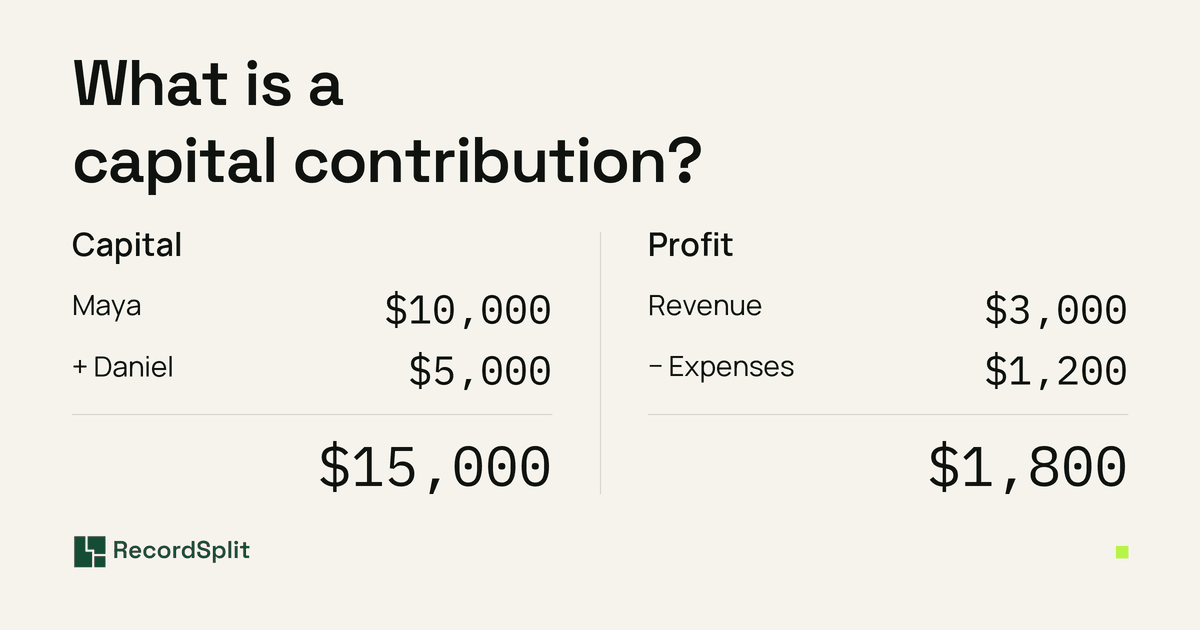
Maya and Daniel start a design studio. Maya contributes $10,000 and Daniel contributes $5,000, both paid into the business account. In the first month the studio earns $3,000 from a customer and spends $1,200 on advertising.
- Capital contributed by Maya
- $10,000.00
- Capital contributed by Daniel
- $5,000.00
- Total capital contributed
- $15,000.00
- Revenue (from a customer)
- $3,000.00
- Expenses (advertising)
- $1,200.00
- Profit (revenue − expenses)
- $1,800.00
Example figures, not customer data.
The studio's profit is $1,800: $3,000 of revenue minus $1,200 of expenses. The $15,000 of capital is not part of that calculation. If every transaction went through the business account, the account would hold $16,800 — but that is cash on hand, not profit. The business made $1,800; the owners put in $15,000.
Maya contributing $5,000 more than Daniel doesn't mean Daniel owes Maya $5,000, and it doesn't change how they share profit unless their agreement says so. The contributions are a record of what each owner put in.
Capital contribution vs revenue
In short
| Compared on | Capital contribution | Revenue |
|---|---|---|
| Where the money comes from | An owner | A customer or client |
| Why it comes in | To fund the business | Payment for goods or services |
| Effect on profit | None | Increases profit |
| Recorded against | The owner who contributed | The sale, invoice or customer |
Mixing the two is the most common capital-contribution mistake. If an owner's $10,000 is recorded as a sale, the business looks $10,000 more profitable than it is, and any profit shared between owners is overstated.
Capital contribution vs owner's draw
In short
The two are opposite directions of the same relationship between an owner and the business. A contribution increases the money the business has to work with; a draw reduces it. Neither changes profit: a draw is not a business expense, even though money leaves the business account.
In RecordSplit, money an owner takes out is recorded as an owner withdrawal on the business account it came from. It lowers that account's balance and doesn't reduce profit. How draws are taxed depends on the business structure, so check the treatment with your accountant. Read more about how an owner's draw works.
Capital contribution vs an owner-paid business expense
In short
Suppose Maya pays a $1,200 advertising bill on her personal card. The business has a $1,200 advertising expense, so its profit is $1,200 lower — exactly as if the business account had paid. What's different is who funded it: Maya, not the business.
That is not the same as Maya contributing $1,200 of capital. A contribution would put $1,200 into the business without creating any expense. The owner-paid expense creates an expense and a record that Maya personally covered a business cost, which owners usually settle between themselves or reimburse.
RecordSplit tracks owner-paid expenses as expenses marked with the owner who paid, and shows their effect on each owner's Partner Balance. See expense tracking for how business-paid and owner-paid expenses are recorded, and business expenses paid personally for the full picture.
Capital contribution vs owner loan
An owner can also lend money to the business instead of contributing it. The difference is the expectation of repayment:
- A loan is expected to be repaid, usually on agreed terms such as a schedule or interest.
- A capital contribution is an investment in the business. It isn't repaid on a schedule, although owners may agree how it is treated if someone leaves or the business closes.
Which one an owner's money is depends on what the owners agree, so write it down at the time. RecordSplit doesn't have a separate owner-loan feature; its Capital page records contributions only.
| Record | Direction of money | Changes profit? | Usually recorded against |
|---|---|---|---|
| Capital contribution | Owner → business | No | The owner who contributed |
| Revenue | Customer → business | Yes, increases it | The sale, invoice or customer |
| Owner's draw | Business → owner | No | The owner who took it |
| Owner-paid expense | Owner pays a business cost directly | Yes, reduces it | The expense, marked with the owner who paid |
| Owner loan | Owner → business, to be repaid | Not the loan itself | The owner, as a loan with its own terms |
How multiple owners can track capital contributions
When several owners contribute — often in different amounts and at different times — a clear record avoids disagreements later. For each contribution, record:
- Which owner made it.
- The date and the amount, or the agreed value for property or equipment.
- A short note: what it was for, or what was contributed if it wasn't cash.
- Where the money went, such as which business account it was deposited into.
Then keep three habits:
- Keep contributions out of revenue and expenses, so profit stays accurate.
- Correct mistakes by voiding the wrong entry with a reason rather than deleting it, so the history stays complete.
- Review each owner's total from time to time, so everyone agrees on who has put in what.
Owners don't need to contribute equal amounts. Unequal contributions are common; what matters is that each one is recorded and that the owners agree how contributions relate to ownership and profit sharing.
How RecordSplit handles capital contributions
RecordSplit is built for small businesses with more than one owner. Its Capital page keeps contributions separate from the operating numbers:
- Record each contribution against the owner who made it, with the amount, date and an optional note.
- See the total capital contributed and each owner's total, alongside a contribution history that shows who recorded each entry.
- Each owner records their own contributions; the primary owner can also record for any owner, and corrects mistakes by voiding an entry with a reason. Voided entries stay in the history.
- Capital is visible to owners only. Staff you invite to RecordSplit don't see it.
- Optionally choose the business account the money was deposited into. That account's recorded balance goes up — which is what the money did — while revenue, expenses and profit stay the same.
- Capital doesn't change revenue, expenses, profit or Partner Balance, so it never inflates profit or creates a balance between owners.

Owner-paid expenses, revenue an owner received personally and settlements between owners are separate records; partner financeexplains how they make up each owner's balance. With capital tracked apart from revenue and expenses, every owner sees the same record of who put what into the business.
Frequently asked questions
What is a capital contribution?
Is a capital contribution revenue?
Does a capital contribution increase profit?
What is the difference between a capital contribution and an owner's draw?
Is paying a business expense personally a capital contribution?
Can business partners contribute different amounts?
Do capital contributions need to be equal?
How should a small business track owner contributions?
Track capital separately from revenue and expenses.
RecordSplit helps small businesses with multiple owners track capital contributions, revenue, expenses, profit, owner-paid costs and each owner's balance — each kept in its place.