
Guide
Invoice payment terms: what they mean and how to write them
Published · By RecordSplit
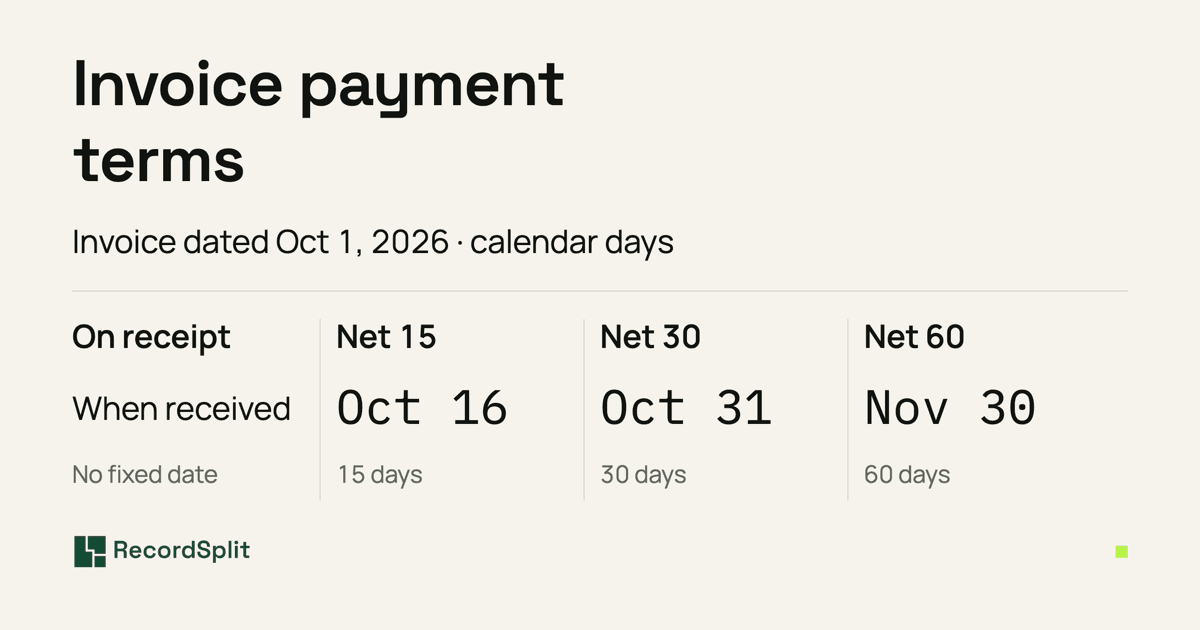
Invoice payment terms tell your customer when you expect to be paid. They usually say how long the customer has to pay, such as "Net 30" or "due upon receipt", and can also cover how to pay, deposits, discounts for paying early or other conditions you agreed.
Payment terms aren't the same as the due date. The terms are the rule; the due date is the actual date that rule produces for one invoice. "Net 30" on an invoice dated October 1 gives a due date of October 31.
This guide compares the common terms, shows how to write them on an invoice with copy-ready wording, and covers deposits, early-payment discounts and what to do when an invoice is paid late. If you invoice with RecordSplit, see how invoicing and receivables handles due dates and terms.
Common invoice payment terms
These are the payment terms you'll see most often on invoices. None of them is a universal standard: which one fits depends on your business, your customers and what you agree with them.
| Payment term | Meaning | Example due date | Typical use |
|---|---|---|---|
| Due upon receipt | Payment is expected as soon as the customer receives the invoice | Depends on when it's received | One-off jobs, new customers, small amounts |
| Net 7 | Payment is due within 7 days of the invoice date | October 8, 2026 | Short jobs and quick payment cycles |
| Net 15 | Payment is due within 15 days | October 16, 2026 | A short credit period |
| Net 30 | Payment is due within 30 days | October 31, 2026 | Common in business-to-business invoicing |
| Net 45 | Payment is due within 45 days | November 15, 2026 | Longer payment cycles |
| Net 60 | Payment is due within 60 days | November 30, 2026 | Extended periods, often for larger customers |
| Net 90 | Payment is due within 90 days | December 30, 2026 | Longer credit arrangements |
The dates count calendar days, including weekends, from the invoice date. To work out the due date for any invoice date or number of days, use the invoice due date calculator.
Some terms don't reduce to a number of days:
| Payment term | What it means |
|---|---|
| End of month (EOM) | Payment is tied to the end of a month rather than the invoice date. "30 EOM" usually means 30 days after the end of the month the invoice is dated in. Usage varies, so spell out the date. |
| 2/10 Net 30 | An early-payment discount: the customer may take 2% off by paying within 10 days; otherwise the full amount is due within 30 days. |
| Payment in advance | The customer pays in full before the work starts or the goods are sent. |
| Deposit | Part of the price is paid up front, and the rest later, often on completion. |
| Milestone payments | Payments fall due as agreed stages of a project are completed, so the dates depend on the project, not the calendar. |
Payment terms vs the invoice due date
Payment terms describe the arrangement you agreed with the customer. The due date is the specific day payment is expected on one invoice, worked out from those terms and the invoice date.
- Payment terms
- Net 30
- Invoice date
- October 1, 2026
- Due date
- October 31, 2026
October 31, 2026 is a Saturday. Whether payment can wait until the next business day depends on your agreement.
Put both on the invoice: the terms explain the rule, and the due date removes any doubt about which day you mean. Counting questions such as calendar days versus business days, and dates that fall on a weekend, are covered on the due date calculator page.
How to write payment terms on an invoice
Good payment terms are short, specific and impossible to misread. Put them near the total or the due date, use the same wording on every invoice, and make sure they match what you agreed with the customer. Here are examples you can adapt:
Due upon receipt
Payment is due upon receipt of this invoice.
Net 15
Payment is due within 15 calendar days of the invoice date.
Net 30
Payment is due within 30 calendar days of the invoice date.
Net 60
Payment is due within 60 calendar days of the invoice date.
Payment in advance
Payment is required in full before work begins.
Deposit
A 50% deposit is due before work begins. The remaining balance is due on completion.
Milestone payments
Each payment is due when the matching project milestone, as agreed for this project, is completed.
Early-payment discount (2/10 Net 30)
Take a 2% discount if payment is received within 10 days of the invoice date. Otherwise, the full amount is due within 30 days.
Next to the terms, say how to pay: bank transfer details, the payment methods you accept, or who to contact. The terms say when; the payment instructions say how.
About these examples
How to choose payment terms
There's no single best payment term. A few things usually shape the choice:
- Your cash flow: the longer customers take to pay, the longer you carry the cost of the work.
- The customer's payment history: a customer who pays reliably may get longer terms than a new one.
- The invoice amount: small amounts are often due on receipt or within a few days.
- How long the project runs: long projects often use deposits or milestone payments instead of one invoice at the end.
- The relationship: larger customers may ask for their own standard terms.
- What's usual in your industry: customers may expect terms similar to other suppliers'.
- Your admin time: longer terms mean more open invoices to track and follow up.
- Consistency: using the same terms for similar customers makes them easier to apply and explain.
Shorter terms bring cash in sooner but can be harder for some customers to meet. Longer terms can suit customers with slower approval processes but leave more money outstanding. Whatever you choose, agree it before the work starts, not on the invoice afterwards.
Deposits, milestones and partial payments
These three are often confused:
- A deposit is part of the price paid up front, before the work starts. The rest is paid later.
- Milestone payments split a project into agreed stages, with a payment due as each stage is completed.
- A partial payment is a customer paying part of an invoice they already have. The rest of that invoice is still owed.
RecordSplit records partial payments against an invoice, and the invoice shows what is still owed. It doesn't have dedicated deposit or milestone invoices; you can describe a deposit or milestone arrangement in the invoice's terms and record each payment as it arrives.
Early-payment discounts
"2/10 Net 30" means the customer may take a 2% discount by paying within 10 days of the invoice date; otherwise the full amount is due within 30 days.
- Paid by October 11, 2026 (within 10 days)
- $980.00
- Otherwise, due by October 31, 2026
- $1,000.00
A discount trades a little revenue for faster payment. Offer one only if it suits your margins, and put the exact terms on the invoice.
What happens when an invoice is paid late?
When the due date passes without payment, work through the basics before anything else:
- Check the invoice status, so you know nothing has been recorded since.
- Check whether a payment is already on its way or still processing.
- Confirm the due date the customer agreed to.
- Contact the customer politely to ask about it.
- Send a payment reminder that states the amount, the due date and how to pay.
- Keep following up on whatever balance is still unpaid.
For wording at each stage, from a friendly note to a final reminder, use these payment reminder email templates.
A late fee belongs on an overdue invoice only if your agreement with the customer includes one and it is permitted where you do business. If it does, the late fee calculatorworks out the charge at the rate you already agreed. It doesn't tell you whether a fee is allowed.
How RecordSplit handles invoice payment terms
Set your default payment due days and invoice terms once, then adjust individual draft invoices when needed:
- In Invoice Settings, set Payment due (days), which starts at 14, and default Terms and Payment instructions text.
- Each new draft invoice gets a due date of the issue date plus that many calendar days, with your default Terms and Payment instructions filled in.
- On a draft, you can change the due date, the Terms and the Payment instructions for that invoice before you issue it.
- The Terms and Payment instructions appear on the invoice your customer views and on its PDF.
- Record payments in full or in part as they arrive, and send a payment reminder when you decide to.
Terms text and the due date are separate
RecordSplit doesn't have a Net 15 / Net 30 / Net 60 selector, deposit or milestone invoices, early-payment discounts, late fees or interest, or scheduled reminders, and it doesn't collect payments online. See invoicing and receivables for what it does.
To keep an eye on due dates outside RecordSplit, the free invoice tracker spreadsheet lists each invoice with its due date, status and days overdue, and the accounts receivable aging template shows how much is still current and how much has moved past its due date.
Frequently asked questions
What are payment terms on an invoice?
What are common invoice payment terms?
How do you write payment terms on an invoice?
What is an example of invoice payment terms?
What's the difference between payment terms and a due date?
What does payment terms 14 days net mean?
What does 30 EOM mean?
Should a small business use Net 15 or Net 30?
Put your due date and terms on every invoice.
Set default payment due days, terms and payment instructions once, and adjust each draft invoice when you need to. Record payments as they arrive and see what's still owed.